Free Bacteriostatic Water
Lab Tested and Shipped from the USA
Free Shipping on Orders Over $200
The Purest Peptides. Period.

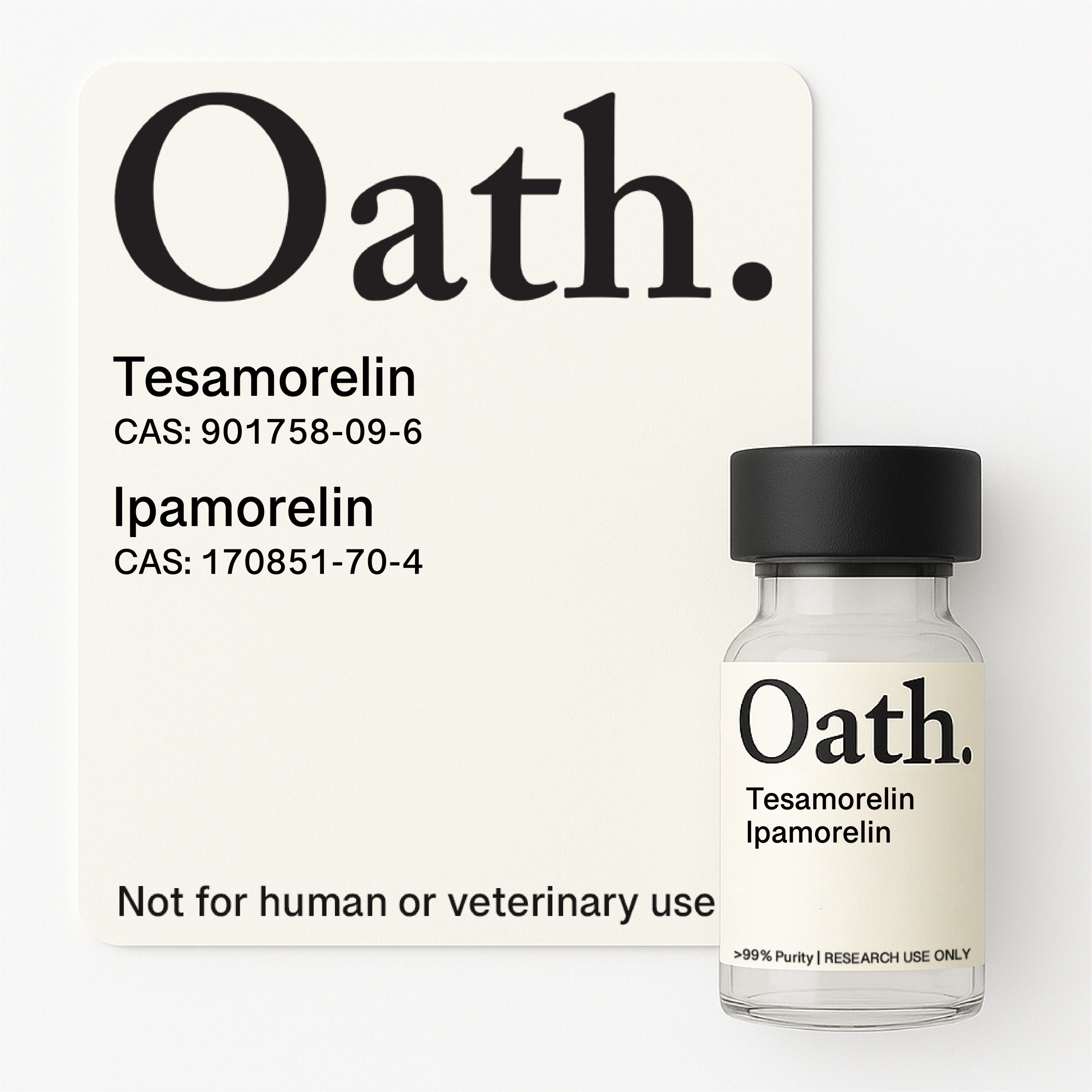
Tesamorelin + Ipamorelin

Price range: $105.00 through $225.00

This synergistic blend combines two complementary growth hormone-releasing peptides studied for their combined effects on GH secretion and metabolic health. Tesamorelin, a GHRH analog, is researched for its ability to reduce visceral fat and increase IGF-1 levels, while Ipamorelin, a selective GHRP, offers the advantage of not elevating cortisol or prolactin like other GHRPs—designed for studies exploring growth hormone physiology and body composition.

Available in two concentrations: a standard 8mg blend (Tesamorelin 6mg + Ipamorelin 2mg) and a higher-dose 15mg option (Tesamorelin 10mg + Ipamorelin 5mg) for research requiring increased peptide loads.

2 Day FAST Shipping

99%+ Purity Tests

Ships from Gilbert Arizona

USA Lab Tested

Free bacteriostatic water with every order.
Buy 1 pieces
$105.00
Total:
$105.00
10% off
Buy 3 pieces and save 10%
$105.00
$94.50
Total:
20% off
Buy 6+ pieces and save 20%
$105.00
$84.00
Total:

Overview

The Tesamorelin + Ipamorelin blend combines two growth hormone secretagogues that operate through complementary receptor pathways. Tesamorelin activates GHRH receptors via the cAMP pathway, while Ipamorelin selectively targets GHS-R1a receptors without the cortisol or prolactin elevations seen with other GH-releasing peptides.

Research demonstrates that simultaneous activation of both pathways produces synergistic—not merely additive—growth hormone release. This dual-pathway approach makes the combination particularly valuable for investigators studying GH physiology and related metabolic processes.

This product is strictly for research purposes only. Not approved for human or animal use.

Key Characteristics

TESAMORELIN PROFILE

Formula: C₂₂₁H₃₆₆N₇₂O₆₇S

Weight: 5135.9 g/mol

CAS: 901758-09-6

Structure: 44 amino acid GHRH analog

Receptor: GHRH receptor (cAMP/PKA pathway)

IPAMORELIN PROFILE

Formula: C₃₈H₄₉N₉O₅

Weight: 711.86 g/mol

CAS: 170851-70-4

Structure: Pentapeptide (Aib-His-D-2-Nal-D-Phe-Lys-NH₂)

Receptor: GHS-R1a (IP3/calcium pathway)

BLEND PHYSICAL PROPERTIES

Form: White to off-white lyophilized powder

Solubility: Water-soluble

Storage: Keep refrigerated 36‑46 °F (2‑8 °C)

Stability: Stable when properly stored

How It Works

This blend activates two distinct receptor pathways on pituitary somatotroph cells to produce synergistic growth hormone release. Studies demonstrate that simultaneous activation of both pathways results in cross-amplification—each compound enhances the signaling cascade of the other, yielding GH secretion greater than either achieves independently.

Tesamorelin Pathway (GHRH)

GHRH Receptor Activation

Binds to GHRH receptors on pituitary somatotrophs, activating Gs protein-coupled adenylate cyclase and increasing intracellular cAMP concentrations.

Protein Kinase A Cascade

Elevated cAMP activates Protein Kinase A (PKA), triggering the signaling cascade that leads to growth hormone gene transcription and GH vesicle release.

Pulsatile GH Amplification

Augments both basal and pulsatile GH secretion patterns, maintaining physiological release rhythms while increasing overall output.

Ipamorelin Pathway (GHRP)

Ghrelin Receptor Activation

Selectively binds GHS-R1a (ghrelin receptor), activating Gq/11 protein coupled to phospholipase C, triggering IP3/DAG signaling and calcium mobilization.

Cross-Pathway Enhancement

GHS-R1a-mediated PKC activation amplifies GHRH-induced cAMP accumulation, creating true synergy rather than simple additive effects.

Somatostatin Suppression

GHRPs reduce hypothalamic somatostatin release, removing a physiological brake on GHRH action and further enhancing the synergistic response.

Research Findings

Clinical and laboratory investigations have documented the individual benefits of each component as well as the synergistic potential of combined GHRH-GHRP administration.

GHRH-GHRP Synergy

Landmark studies demonstrate true synergistic effects when GHRH and GHRP pathways are activated simultaneously.

Submaximal doses of GHRP + GHRH produce synergistic GH release (Bowers 1990)
GHRPs show substantially greater GH release than GHRH alone in clinical studies
Ipamorelin uniquely avoids cortisol/ACTH elevation seen with other GHRPs (Raun 1998)
Synergy correlates negatively with age and visceral fat (Veldhuis 2009)
IGF-I and IGFBP-3 explain 60% of variability in GHRH-GHRP synergy

Visceral Fat Reduction

Tesamorelin clinical trials demonstrate significant reductions in metabolically active visceral adipose tissue.

15.2% visceral fat reduction vs 5% increase in placebo (NEJM 2007)
27.8 cm² decrease in VAT area over 26 weeks
69-70% of patients achieved ≥8% VAT reduction
Selective reduction—subcutaneous fat relatively unchanged
FDA-approved indication for HIV-associated lipodystrophy

IGF-1 and Growth Hormone

Research shows robust increases in IGF-1 and enhanced GH pulsatility with GHRH analog administration.

81% increase in IGF-1 levels in tesamorelin group (NEJM 2007)
IGF-1 increased by 181 μg/L with tesamorelin (Stanley 2010)
Augmented both basal and pulsatile GH secretion
Mean overnight GH increased +0.5 μg/L (P = 0.004)
Preserved peripheral insulin-stimulated glucose uptake

Ipamorelin Selectivity

Ipamorelin demonstrates unique selectivity among growth hormone secretagogues, avoiding unwanted hormonal effects.

First selective GHS—no ACTH or cortisol release even at >200x ED50 (Raun 1998)
Selectivity profile similar to GHRH itself
No prolactin elevation unlike GHRP-2 and GHRP-6
Minimal appetite stimulation compared to other GHRPs
Well-tolerated in Phase II clinical trials

Body Composition & Muscle

Studies demonstrate improvements in lean mass, muscle density, and overall body composition.

1.2-1.3 kg lean mass gain vs slight loss in placebo (Phase III trials)
Increased density of four truncal muscle groups (p<0.005)
Increased rectus and psoas muscle area by 0.44-0.46 cm²
Reduced liver fat content in clinical trials
Prevention of liver inflammation progression

Metabolic & Cognitive Support

Research suggests potential benefits for metabolic health and cognitive function.

Improved metabolic parameters in clinical populations
Cognitive improvements in mild cognitive impairment subjects
Liver fat reduction without hepatotoxicity
Generally well-tolerated in long-term clinical trials
Preserved insulin sensitivity during treatment

Potential Side Effects in Research

Clinical trials of both components have reported manageable safety profiles. Notably, ipamorelin’s unique selectivity means it does not elevate cortisol or ACTH—unlike other GHRPs such as GHRP-2 and GHRP-6.

Injection Site Reactions

Most common adverse effect in tesamorelin trials including redness, itching, and mild swelling—typically self-limiting

Fluid Retention

Peripheral edema (fluid retention) and joint discomfort reported in clinical studies, consistent with GH-related effects

Musculoskeletal Effects

Arthralgia (joint pain) and myalgia (muscle pain) reported, typically mild and manageable

Metabolic Monitoring

IGF-1 elevation requires monitoring; periodic glucose assessment recommended during long-term research

Tesamorelin is FDA-approved and has been generally well-tolerated in clinical trials. Ipamorelin’s selectivity profile means it does not elevate cortisol, ACTH, or prolactin—a significant advantage over other GHRPs. Researchers should maintain detailed records of any observed effects during their investigations.

IMPORTANT: This product is exclusively for laboratory research purposes and is not approved for human or veterinary use.

References

  1. Bowers CY, et al. Growth hormone (GH)-releasing peptide stimulates GH release in normal men and acts synergistically with GH-releasing hormone. J Clin Endocrinol Metab. 1990;70(4):975-82.
  2. Raun K, et al. Ipamorelin, the first selective growth hormone secretagogue. Eur J Endocrinol. 1998;139(5):552-61.
  3. Falutz J, et al. Metabolic effects of a growth hormone-releasing factor in patients with HIV. N Engl J Med. 2007;357(23):2359-70.
  4. Veldhuis JD, et al. Determinants of GH-releasing hormone and GH-releasing peptide synergy in men. Am J Physiol Endocrinol Metab. 2009;296(5):E1085-92.
  5. Stanley TL, et al. Effect of tesamorelin on visceral fat and liver fat in HIV-infected patients with abdominal fat accumulation: a randomized clinical trial. JAMA. 2014;312(7):707-16.
  6. Erlandson KM, et al. Tesamorelin decreases muscle fat and increases muscle area in adults with HIV. J Frailty Aging. 2018;7(4):265-271.
  7. Stanley TL, et al. Effects of a growth hormone-releasing hormone analog on endogenous GH pulsatility and insulin sensitivity in healthy men. J Clin Endocrinol Metab. 2010;95(12):E470-78.
  8. Arvat E, et al. Effects of GHRP-2 and Hexarelin, two synthetic GH-releasing peptides, on GH, prolactin, ACTH and cortisol levels in man. Peptides. 1997;18(6):885-91.
  9. Beck DE, et al. Prospective, randomized, controlled, proof-of-concept study of ipamorelin for the management of postoperative ileus. Int J Colorectal Dis. 2014;29(12):1527-34.
  10. LiverTox: Clinical and Research Information on Drug-Induced Liver Injury. Tesamorelin. NCBI Bookshelf. 2020.
Weight0.08 lbs
Dimensions0.87 × 1.18 × 0.87 in
Size

8mg, 15mg

Updating
  • No products in the cart.