Free Bacteriostatic Water
Lab Tested and Shipped from the USA
Free Shipping on Orders Over $200
The Purest Peptides. Period.

SS-31

$400.00

SS-31 (Elamipretide) is a mitochondria-targeted tetrapeptide that binds to cardiolipin in the inner mitochondrial membrane. Research suggests it stabilizes cristae structure, enhances ATP production, and reduces oxidative stress at the source. Studies have investigated its potential in cardiovascular protection, kidney function during ischemic events, and skeletal muscle performance during aging. This lyophilized powder requires reconstitution with bacteriostatic water before research use.

2 Day Shipping

Secure Checkout

Satisfaction Guarantee

USA Tested

Not for human or veterinary use. Research use only.

Buy 1 pieces
$400.00
Total:
$400.00
10% off
Buy 3 pieces and save 10%
$400.00
$360.00
Total:
20% off
Buy 6+ pieces and save 20%
$400.00
$320.00
Total:

Overview

Think of SS-31 as your mitochondria’s personal bodyguard—a specialized tetrapeptide engineered to penetrate deep into your cellular power plants and protect them from the inside out. Just as a skilled security guard positions themselves at the most vulnerable entry points, SS-31 targets cardiolipin, a critical phospholipid in the inner mitochondrial membrane, stabilizing the very architecture that keeps your cells producing energy efficiently.

Also known as Elamipretide or Bendavia, SS-31 represents one of the most exciting advances in mitochondrial-targeted therapeutics. This compact four-amino-acid peptide (D-Arg-Dmt-Lys-Phe-NHâ‚‚) has captured the attention of researchers worldwide for its remarkable ability to cross mitochondrial membranes and concentrate precisely where oxidative damage occurs most. Unlike broad-spectrum antioxidants that work throughout the cell, SS-31 acts with surgical precision at the mitochondrial level.

What makes SS-31 particularly fascinating is its mechanism—it doesn’t just neutralize free radicals like conventional antioxidants. Instead, it stabilizes the electron transport chain itself, reducing the production of reactive oxygen species at their source while simultaneously enhancing ATP production. This dual action of protection and performance enhancement has made it a compelling subject of research in cardiovascular disease, aging, kidney protection, and neurodegenerative conditions.

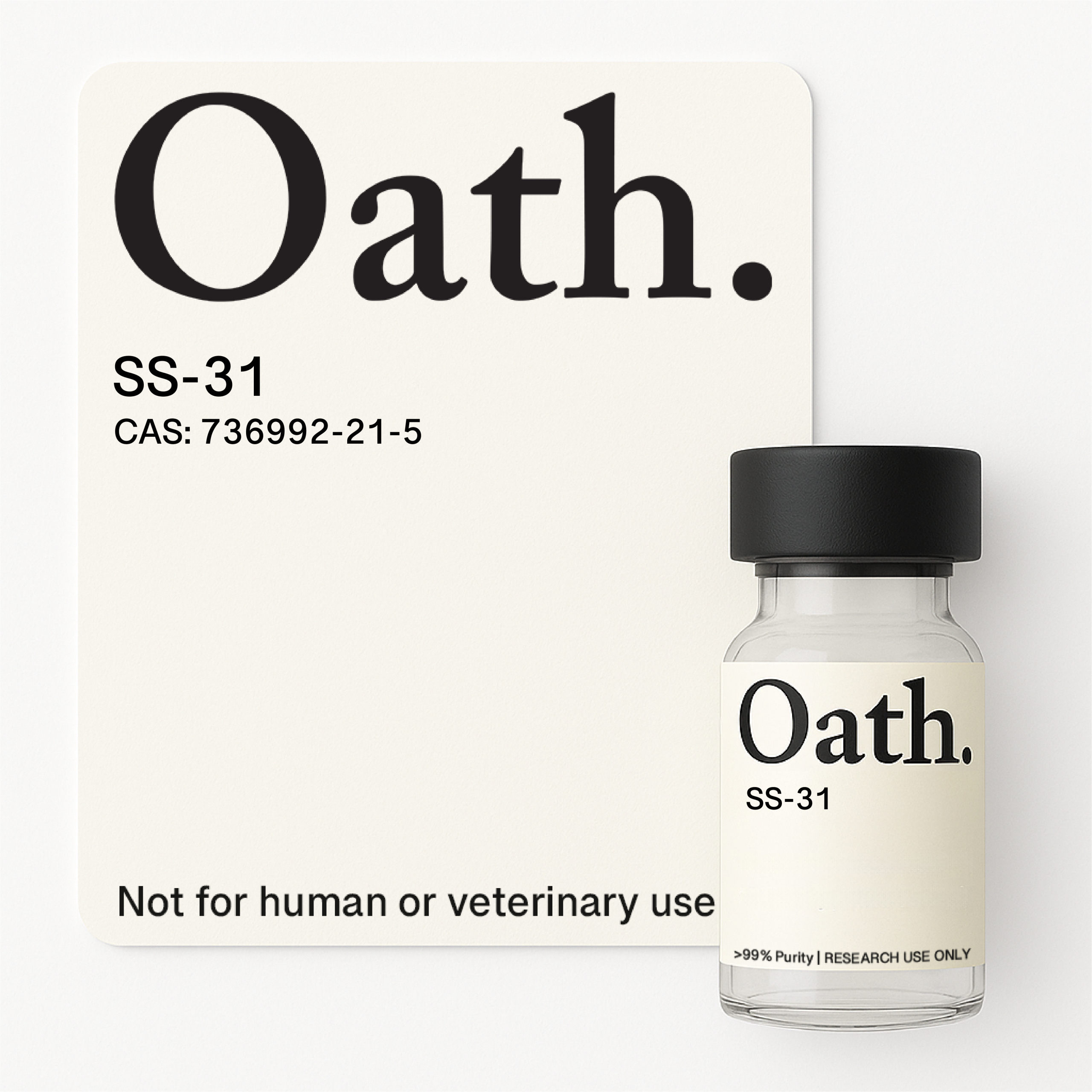
This product is strictly for research purposes only. Not approved for human or animal use.

Key Characteristics

MOLECULAR PROFILE

Formula: C₃₂H₄₉N₉O₅

Weight: 639.8 g/mol

CAS: 736992-21-5

Sequence: D-Arg-Dmt-Lys-Phe-NHâ‚‚

PHYSICAL PROPERTIES

Form: White to off-white lyophilized powder

Solubility: Water-soluble

Storage: Keep refrigerated 36‑46 °F (2‑8 °C)

Stability: Stable when properly stored

How It Works

SS-31 operates like a precision tool for mitochondrial maintenance, concentrating 1,000 to 5,000-fold within mitochondria due to electrostatic attraction between its positively charged amino acids and the negatively charged cardiolipin in the inner membrane. This targeted accumulation allows it to protect the electron transport chain from oxidative damage while enhancing energy production efficiency.

Primary Mechanisms

Cardiolipin Stabilization

Binds directly to cardiolipin via electrostatic interactions, preventing oxidative damage to this essential phospholipid and maintaining cristae structure—the folds in the inner mitochondrial membrane where energy production occurs.

Electron Transport Chain Optimization

Interacts with key proteins in the oxidative phosphorylation pathway including Complex III, Complex IV, and ATP synthase, enhancing electron transfer efficiency and reducing electron leakage that would otherwise generate harmful reactive oxygen species.

Cytochrome C Modulation

Inhibits the peroxidase activity of cytochrome c, preventing it from contributing to oxidative stress while maintaining its essential role in the electron transport chain.

Secondary Effects

ATP Production Enhancement

By improving mitochondrial coupling efficiency (P/O ratio), SS-31 enables more ATP to be produced per unit of oxygen consumed, restoring aged mitochondria to more youthful function levels.

Oxidative Stress Reduction

Decreases mitochondrial ROS production at the source rather than scavenging free radicals after they form, representing a fundamentally different approach to antioxidant protection.

Membrane Potential Preservation

Helps maintain healthy mitochondrial membrane potential, which is essential for proper ATP synthesis and cellular signaling.

Research Findings

Laboratory and clinical investigations have revealed multiple areas where SS-31 demonstrates significant therapeutic potential, from cardiovascular protection to healthy aging support.

Cardiovascular Protection

Multiple studies demonstrate significant cardioprotective effects in various models of heart disease.

Improves cardiac function in heart failure models
Reduces ischemia-reperfusion injury in cardiac tissue
Attenuates age-associated protein modifications in heart (2021)
Restores cardiac mitochondrial morphology in Barth syndrome models (2024)
Improves ADP sensitivity through adenine nucleotide translocator (2023)

Skeletal Muscle & Exercise Performance

Research shows remarkable improvements in aged muscle function and exercise capacity.

Single treatment restores mitochondrial energetics to young levels in aged mice
8 weeks treatment reverses age-related decline in ATP production
Improved treadmill endurance and fatigue resistance
Restored redox homeostasis in aged skeletal muscle
Partial preservation of muscle mass in aging models

Renal Protection

Clinical and preclinical studies show kidney-protective effects, particularly during ischemic events.

Phase 2a trial: Attenuated post-procedural kidney hypoxia during stent revascularization
Increased renal blood flow and improved kidney function
Reduced kidney injury in ischemia-reperfusion models
Accelerated ATP recovery in renal tissue after injury

Neuroprotective Properties

Emerging research suggests protective effects on brain cells and cognitive function.

Ameliorates memory impairment in neuroinflammation models (2019)
Regulates BDNF signaling pathways
Reverses synaptic-signaling protein changes
Protects against cerebral microhemorrhage in aged models (2024)
Reduces neuroinflammation markers

Barth Syndrome Research

FDA-approved indication based on extensive clinical trial data in this rare mitochondrial disorder.

TAZPOWER trial: 12-patient Phase 2/3 randomized clinical trial with 168-week extension
Significant improvements in 6-minute walk test
Increased cardiac stroke volume over long-term treatment
Improved knee extensor muscle strength
FDA accelerated approval granted September 2025

Potential Side Effects in Research

Clinical trials have reported a generally favorable safety profile for SS-31, with most adverse events being mild and transient. However, as with any research compound, careful monitoring is essential.

Injection Site Reactions

Most common adverse effect in clinical studies including pruritus (39%), pain (28%), erythema (19%), induration (14%), and bruising (13%)—typically mild and self-limiting

Systemic Effects

Occasional reports of mild headache, dizziness, and gastrointestinal effects such as nausea, flatulence, or abdominal discomfort

Dose Tolerance

Well-tolerated as IV infusion over wide dose range (0.01–0.25 mg/kg/h over 4 hours) and as subcutaneous injection (4–40 mg daily for 28 days) in human trials

Long-term Considerations

Limited long-term data beyond clinical trial durations; extended studies (168 weeks) in Barth syndrome patients showed sustained tolerability

No serious adverse reactions or fatalities were observed in clinical studies reviewed. In heart failure and renal artery stenosis trials, SS-31 was well-tolerated with no treatment-limiting serious adverse events. Researchers should maintain detailed records of any observed effects during their investigations.

IMPORTANT: This product is exclusively for laboratory research purposes and is not approved for human or veterinary use.

References

  1. Tung C, et al. Elamipretide: A Review of Its Structure, Mechanism of Action, and Therapeutic Potential. Int J Mol Sci. 2025.
  2. Thompson WR, et al. Long-term efficacy and safety of elamipretide in patients with Barth syndrome: 168-week open-label extension results of TAZPOWER. Genet Med. 2024.
  3. Pharaoh G, et al. The mitochondrially targeted peptide elamipretide (SS-31) improves ADP sensitivity in aged mitochondria by increasing uptake through the adenine nucleotide translocator (ANT). Geroscience. 2023.
  4. Whitson JA, et al. Elamipretide (SS-31) treatment attenuates age-associated post-translational modifications of heart proteins. Geroscience. 2021.
  5. Chavez JD, et al. Mitochondrial protein interaction landscape of SS-31. Proc Natl Acad Sci U S A. 2020.
  6. Mitchell W, et al. The mitochondria-targeted peptide SS-31 binds lipid bilayers and modulates surface electrostatics as a key component of its mechanism of action. J Biol Chem. 2020.
  7. Zhao W, et al. Elamipretide (SS-31) improves mitochondrial dysfunction, synaptic and memory impairment induced by lipopolysaccharide in mice. J Neuroinflammation. 2019.
  8. Campbell MD, et al. Improving mitochondrial function with SS-31 reverses age-related redox stress and improves exercise tolerance in aged mice. Free Radic Biol Med. 2019.
  9. Saad A, et al. Phase 2a Clinical Trial of Mitochondrial Protection (Elamipretide) During Stent Revascularization in Patients With Atherosclerotic Renal Artery Stenosis. Circ Cardiovasc Interv. 2017.
  10. Thompson WR, et al. A phase 2/3 randomized clinical trial followed by an open-label extension to evaluate the effectiveness of elamipretide in Barth syndrome. Genet Med. 2021.
  11. Siegel MP, et al. Mitochondrial-targeted peptide rapidly improves mitochondrial energetics and skeletal muscle performance in aged mice. Aging Cell. 2013.
Weight 0.08 lbs
Dimensions 0.87 × 1.18 × 0.87 in
Size

10mg

Updating
  • No products in the cart.